Summary:

  • The lump at the base of your big toe may be a bunion, but it can also be gout, osteoarthritis, ganglion cysts, or bursitis.
  • Bunions are largely progressive and do not go away on their own.
  • Without treatment, a bunion can progress and lead to secondary problems including hammertoe, metatarsalgia, and calluses.
  • A weight-bearing X-ray is typically used for a bunion diagnosis and grading.
You’ve noticed a bump forming on the side of your big toe. It’s not painful yet, or maybe it is, but either way, you’re not sure if it’s something to watch, something to treat, or something to see a doctor about. Several conditions can cause that bony bump at the side of your big toe, including a bunion. Here’s how to work out what you’re looking at, and when it’s worth seeing a specialist in Singapore

What Is That Bump? The Most Likely Causes

A lump at the base of your big toe can develop for several reasons. The most common include:
Condition What It Is Key Distinguishing Features
Bunion (Hallux Valgus) Structural misalignment of the metatarsophalangeal joint (the joint connecting your big toe to the rest of your foot), causing the toe to angle toward the smaller toes and the joint to protrude - Develops gradually over time
- Firm bony bump on the inner side of the foot
- Persistent, not episodic
Gout Inflammatory arthritis caused by a build-up of uric acid crystals in the joints - Sudden, intense pain and swelling, often overnight
- Flares come and go rather than persist as a structural change
Osteoarthritis Wear-related joint degeneration producing bony spurs (small outgrowths of bone) around the joint - Stiffness and reduced range of motion
- Lump-like appearance without the characteristic toe angulation of a bunion
Ganglion Cyst Fluid-filled sac along a tendon or joint - Feels softer and more moveable than a bony lump
- Less common near the big toe than elsewhere
Bursitis Inflammation of the bursa (a small fluid-filled cushioning sac) near the joint - Localised swelling and tenderness
- Typically worsens with pressure from footwear
Each of these conditions looks and feels different, though some can occur at the same time. A clinical assessment can help you tell them apart.

How to Tell You Have a Bunion

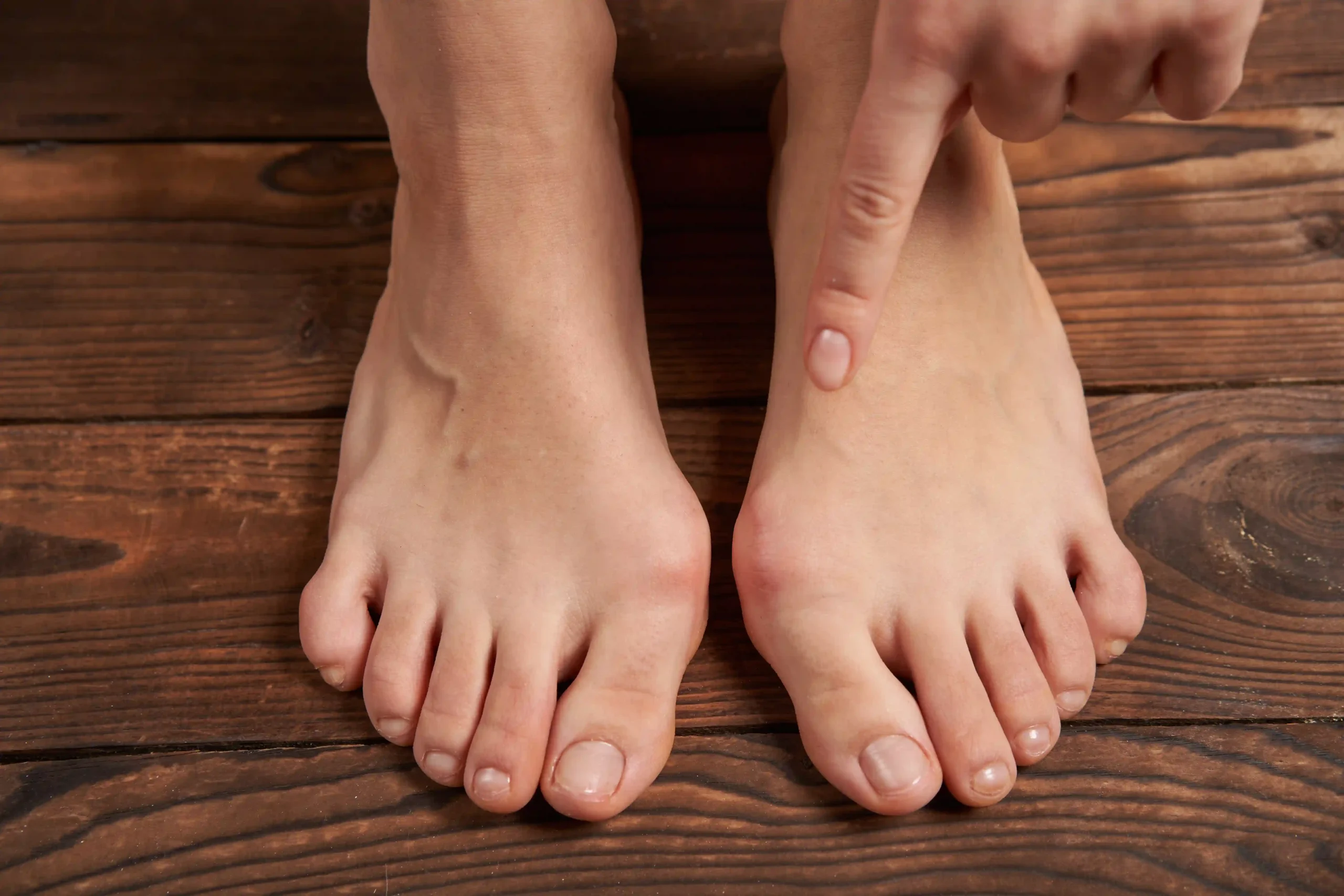
What is a bunion, and is it what you have? The hallmarks of a bunion are fairly recognisable once you know what to look for. 

It’s likely a bunion if:

  • There’s a firm, bony bump on the inner side of your foot at the base of the big toe
  • Your big toe is angling toward your second toe rather than pointing straight ahead
  • There’s redness or redness over the bump, particularly after you wear closed or narrow footwear
  • There’s pain and swelling around the joint of your big toe
  • Your skin is thicker, or callus is forming, over the bony prominence

Bunions develop gradually over months or years, so the change can be subtle at first. Many people live with an early-stage bunion without significant discomfort until their shoe options start to narrow.

Hallux valgus (the clinical term for the big toe deformity that causes a bunion) exists on a spectrum of severity. A mild alignment shift and a severely angulated toe are both bunions, but they call for very different approaches. 

A weight-bearing X-ray can confirm a bunion diagnosis and measure its severity, which is why a proper assessment matters even when symptoms feel minor.

Why Bunions Form: Common Risk Factors

Bunions are largely hereditary. If one of your parents had one, your risk is statistically higher. The inherited component is thought to be foot structure rather than the bunion itself, which may be:

  • Joint laxity (looseness)
  • Flat feet
  • Bone architecture

Women develop bunions more frequently than men, which researchers link to differences in joint laxity and, in some cases, footwear habits over a lifetime.

Other contributing factors include: 

  • Having a long first metatarsal (the bone behind the big toe)
  • Prior foot injury
  • Certain connective tissue conditions

It’s worth noting that wearing heels doesn’t cause bunions if you’re not genetically predisposed. However, if you already have the structural tendency, narrow or high-heeled footwear may accelerate the progression of bunions and worsen symptoms.

Also Read: Is Wearing High Heels Bad for You?

Will My Bunion Get Worse If Left Alone?

Bunions are progressive. Unlike a pulled muscle or a sprained ligament, they don’t heal with rest. The big toe deformity can worsen over time, particularly if footwear habits or daily activity keep placing stress on the joint.

In the early stages, you can get by with wider shoes, bunion pads, and occasional anti-inflammatory medication. But while these measures can ease discomfort, they don’t correct the underlying alignment problem.

As the joint continues to shift, secondary problems can develop: 

  • The second toe may be pushed upward and begin to buckle (a condition called hammertoe).
  • Calluses and corns can form where toes press against each other.
  • The ball of the foot may become painful due to altered weight distribution (metatarsalgia).
  • Skin breakdown over the bony prominence is also a risk, particularly in people with diabetes.

None of this is inevitable. But catching it early usually means more options and a simpler path to bunion treatment in Singapore.

When Should You See a Doctor?

Not every bunion needs urgent attention. But it’s worth getting an assessment if any of the following apply:

  • Pain is affecting your daily activities, work, or exercise
  • You’re struggling to find footwear that fits comfortably
  • Your second toe is being pushed out of its normal position
  • You’ve noticed skin redness, breakdown, or ulceration over the bump
  • The lump is growing noticeably or changing in character

Your GP can provide an initial assessment and refer you on if needed. For severity grading and an overview of various treatment options, though, you may want to see an orthopaedic doctor.

Our foot and ankle specialists at Centurion Orthopaedic Centre treat patients at Mt Elizabeth Novena and Farrer Park. If your assessment points toward treatment, Dr Tan Shi Ming or Dr Bruce Ang CL can walk you through what’s appropriate for your case. 

What Happens at a Bunion Assessment?

If you book a consultation, here’s what to expect.

  1. Physical examination: Your surgeon assesses the angle of your big toe, the mobility of the joint, and whether any secondary deformities are present.
  2. Weight-bearing X-ray: Typically taken while you are standing, this gives an accurate picture of how the joint sits under load.
  3. Severity grading: From the X-ray, your surgeon calculates the angle of deviation and grades the bunion as mild, moderate, or severe.
  4. Discussion of options: For mild to moderate bunions, conservative management (footwear modifications, orthotics, padding, physiotherapy) is often the starting point. Surgery tends to be considered when conservative measures have not resolved the problem, or when the deformity is affecting your daily function.

Frequently Asked Questions

Can I treat a bunion at home?
You can manage symptoms by wearing wider footwear and bunion pads, or using anti-inflammatory medication. These can ease your discomfort, but they won’t correct the underlying alignment. The deformity is likely to persist or progress without proper bunion treatment by a specialist in Singapore.

Not necessarily. Conservative management (wider footwear, orthotics, padding, and physiotherapy) may be sufficient if it’s caught early. Surgery tends to be considered when symptoms persist despite non-surgical measures, or when the big toe deformity is affecting daily function.

Yes. Pain isn’t a requirement for a bunion diagnosis. Some people have a visible deformity with no discomfort at all, though the absence of pain doesn’t mean it won’t progress.
It varies. Some patients notice little change over many years, but it may advance more quickly for others. Factors that may accelerate progression include footwear choices, the underlying foot structure, occupation, and activity level.

Noticed a Bump on the Side of Your Big Toe? Speak to a Specialist at Centurion Orthopaedic Centre

If you’ve been noticing a lump at the base of your big toe and want a diagnosis, our bunion specialist in Singapore can assess your foot and advise on next steps. 

Dr Tan Shi Ming holds a subspecialty fellowship in foot and ankle surgery, sub-specialising in bunions, toe deformities, and ankle conditions, and sees patients at our clinics in Mt Elizabeth Novena and Farrer Park. Dr Bruce Ang CL is also available for orthopaedic assessment.