


Pain at certain angles

Shoulder Pain at certain angles
This is a very common problem where people experience a sharp pain at certain angles, for example, when reaching for an object, or when putting on clothes.
The pain also typically comes down the side of the upper arm. It may last 10 to 20 sec, and be associated with a feeling of weakness. People commonly feel pain when lying on the shoulder at night.
Subacromial Impingement
The most common condition causing such pains at certain angles is Subacromial Impingement.
This means that when the shoulder moves at certain angles, the tendons in the shoulder are rubbed by hard tissue (called bursitis) or the overlying acromion bone.
Impingement can develop out of nowhere or may start after a minor strain or injury of the shoulder. It can affect people in their 20s to 50s.
Other possible conditions
Other possible and associated conditions causing pain at certain angles of the shoulder are:
– Rotator Cuff tendinitis
– Rotator Cuff Calcific Tendinitis
– Labrum tear
– Joint Arthritis
A physical examination by a Shoulder specialist is an important part of the diagnosis to differentiate between the causes. Xrays and MRI are also commonly ordered to evaluate the internal condition. Only after an accurate diagnosis has been made, can appropriate treatment be started.
Frequently Asked Questions
Find quick answers to common queries, designed to help you navigate
your orthopaedic care journey with ease.
You can come see us without having to obtain any referral letters first.
The exception is if you are using a corporate insurance plan, as some corporate insurers require you to see a family doctor on your panel first, and ask for a referral letter to us.
Yes, but it can take one to three years without treatment. Early intervention shortens recovery and reduces the severity of your symptoms. Some patients are left with residual stiffness even after the condition resolves.
Starting frozen shoulder treatment early gives you the best chance of a faster recovery. For most patients, a corticosteroid injection combined with physiotherapy offers the most effective improvement. In more advanced cases, hydrodilatation or arthroscopic release may be more appropriate.
Yes, physiotherapy is one of the main pillars of frozen shoulder treatment. A structured programme of manual therapy and stretching can meaningfully improve range of motion, particularly in the frozen and thawing stages. How consistently you do your home exercises plays a significant role in how quickly you recover.
If your shoulder has been stiff or painful for more than two to three weeks without improvement, get it assessed. Night pain, difficulty reaching behind your back, or restricted overhead movement all warrant specialist review. People with diabetes or thyroid conditions should seek assessment promptly.
Yes. A corticosteroid injection reduces inflammation and pain, making physiotherapy more effective. Hydrodilatation is another option for patients who have not responded to standard injections alone.
Frozen shoulder surgery is considered when pain persists for several months and conservative treatments have not produced adequate improvement. Arthroscopic capsular release is a keyhole procedure that removes the thickened tissue restricting your shoulder. Most patients experience meaningful improvement in pain and mobility in the weeks that follow.
Recurrence in the same shoulder is uncommon. However, some patients develop it in the other shoulder at some point. The second episode does not always follow the same severity or timeline as the first.
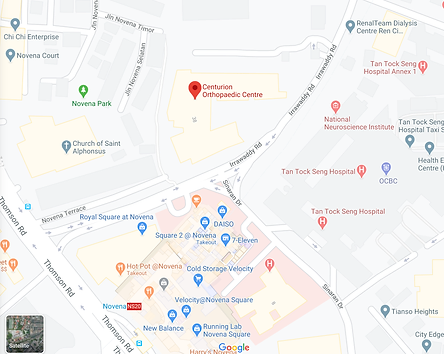
Centurion Orthopaedic Centre
38 Irrawaddy Road
Mt Elizabeth Novena Hospital Specialist Centre #07-40
Singapore 329563